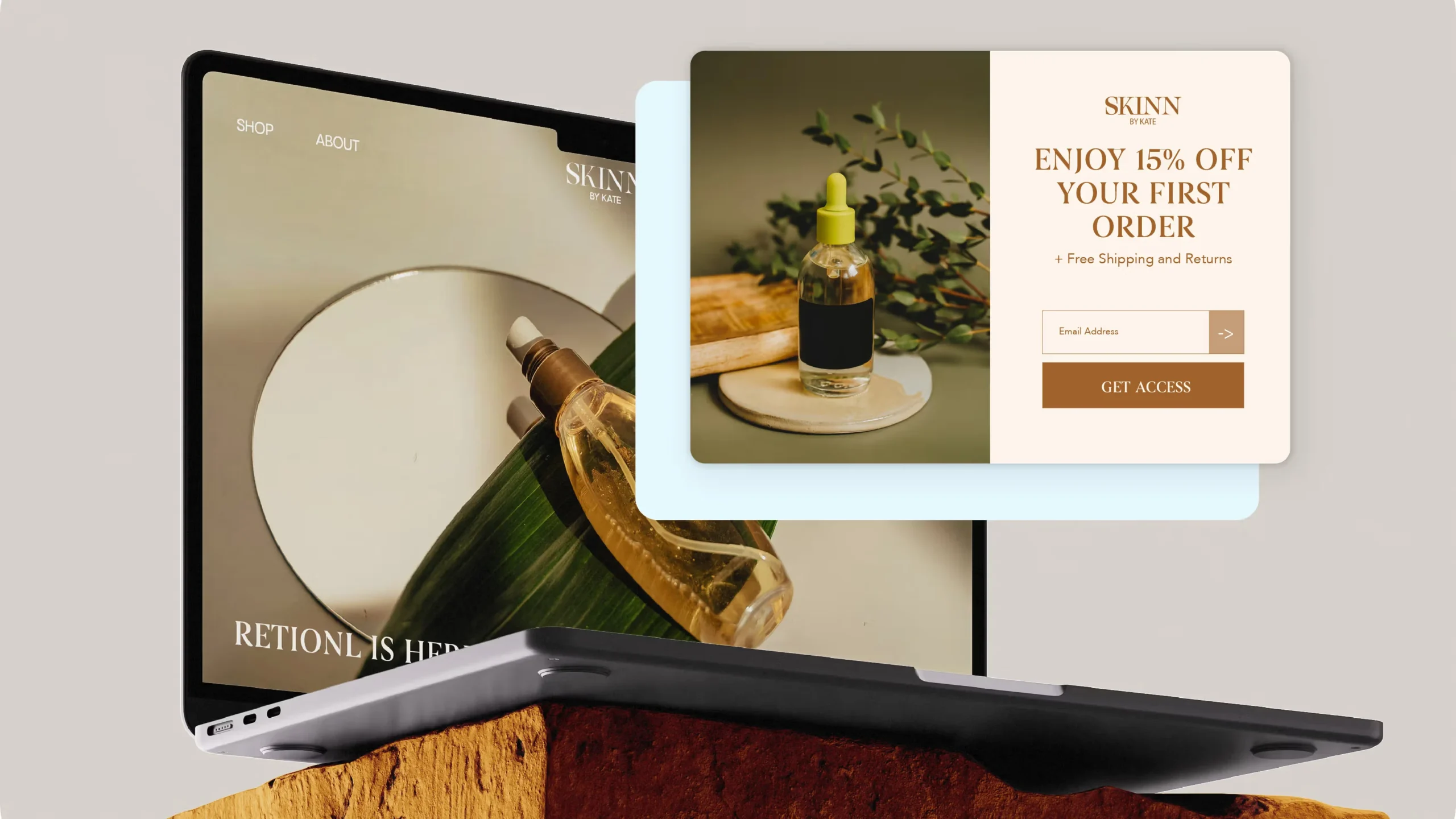
The issue with intrusive overlay advertising is not that users despise ads. It’s that they have come to link certain ad formats with a lack of respect. When that connection is made, it not only kills the click but also impacts their perception of the company’s advertising. That’s what’s important. You can still win back a lost conversion. But it’s much harder to repair a damaged brand relationship.
In this article
The psychology behind banner blindness
For over 20 years, we’ve been aware of a banner ad problem. Users have learned to recognise them as advertisements (often unconsciously) and ignore them. This is known as banner blindness.
Over time, there has been a similar widespread adaptation to other obtrusive advertising methods, which has resulted in a collective conditioning among users. Pop-up ads, auto-playing video ads with sound, interstitial ads with countdowns, and other aggressive formats have caused users (particularly power users, who are likely to be increasingly desensitised) to artificially interact with these methods, because they often must to access the desired content.
Pop-up ads were one of the first successful forms of online advertising. Today, they are one of the most widely despised. Users see a modal and their brain springs into action for one of two choices: fight or flight. Engage with the content or find the ‘x’ to escape. The loss of attention and goodwill may already have been irrecoverably substantial. The damage was done because pop-ups exploited user’s fight or flight responses too effectively.
What intrusive formats actually cost you
The most discussed entry pop-up problem is bounce rate. This is a real problem. If the entry pop fires in the first three seconds of a session, you are by definition catching a user who has not yet had the opportunity to engage with your site. You have instead interrupted their evaluation process with a modal. That specific modal raises your back-button count directly. The question the user had about your site was “Is this relevant to me?” and your modal’s answer was “Join our community.”
But the cost is far more extensive than bounce. There are three separate damage mechanisms running in parallel.
First, the SEO exposure. Google’s Page Experience signals actually penalize this behavior; the exact penalty is “intrusive interstitials blocking content on mobile.” At the technical level, a modal that makes a page jump modally, as it were, is a major contributor to Cumulative Layout Shift. Google is measuring that, and it is directly reducing your search visibility. Brands running the most entry over-the-top overlays are often not connecting the dots that they are paying an organic visibility tax on top of the acquisition damage.
Second, ad blocker penetration. Users who have been burned by bad advertisers protect themselves by installing ad blockers. This is a prevent defense that stops more than the modal you lost them with. It stops all the advertising you will ever use to reach them. Pushy formats don’t just lose you the current user; they lose you that and the exponential audience network density.
Third, and hardest to directly measure, is trust erosion. A user who gets hit with an immediate overlay, closes it, gets hit with one on scroll, closes it, gets hit by an exit intent on their way out, and closes it, has formed an opinion about your brand. It is the same opinion they would form about a pushy salesperson. Some will still buy. Most won’t visit again.
The shift toward under-the-radar engagement
The strategic shift that’s actually working isn’t about abandoning high-visibility formats. It’s about timing and placement. There’s a meaningful difference between an ad that interrupts a user mid-task and one that waits until the task is complete.
This is where the format mechanics start to matter. A popunder loads quietly behind the active browser window rather than in front of it. The user finishes reading the article, comparing the products, or completing the checkout. When they close or minimize that window, the secondary tab is already there, ready to present an offer. The discovery happens on the user’s timeline, not yours.
That timing difference isn’t cosmetic. It changes the emotional context of the interaction entirely. A user who has just completed a task is in a fundamentally different mental state than one who was interrupted three seconds in. They’re more patient, more receptive, and – critically – their experience of your primary site is intact. The brand impression was formed by the content, not the advertising.
From a click-through rate standpoint, background formats tend to outperform traditional overlays not because of better creative, but because of better context. The impression arrives when the user has bandwidth to process it.
Building a qualified delivery framework
It’s not just the format. A non-intrusive format handed to an unqualified user at the wrong frequency will still create waste and irritation. The content is only as good as the mechanics that deliver it. And blocking and tackling matter as much as the creative itself.
How often you need to see the same message is non-negotiable. Eventually, it stops reading as an offer and starts reading as an oversight. You’ll do hard caps per session and per day for sure and make sure a certain minimum time expires between encounters.
And where possible, you’ll swap out time-based triggers for behavior-based ones. You won’t fire the exit overlay after 30 seconds on the page: you’ll fire it after the user has scrolled past 70% of the page. You won’t react to any exit in your product section with 90 seconds on site as if you just missed making a sale. Their visit started from an ad to your pricing page where they spent three minutes. A retargeting heavy user is not in the same buying cycle as a homepage bouncer. And they cost a lot to educate.
Non-intrusive formats in e-commerce and utility contexts
E-commerce brands struggle with a version of this problem: checkout abandonment. A user who has added items to a cart and reached the checkout page is a high-intent prospect. Interrupting that flow with a pop-up – which might even be a spot-on thing presenting a discount code – introduces friction at exactly the wrong moment. The cognitive switch from “complete this purchase” to “evaluate this offer” costs you more conversions than the discount is worth.
Instead, put the offer somewhere it won’t interrupt the transaction. The background tab that loads when a user enters the checkout flow, presenting the discount code post-transaction or as a follow-up for users who abandoned the purchase. You’ll get all of the sales you would have lost while protecting the ones you wouldn’t.
Slightly less obviously, a similar problem can occur at the beginning of the funnel with that pop-up’s gimmick cousin: the lead magnet offer. A downloadable template, checklist, or browser extension is also valuable. But if it’s presented as an immediate overlay, it can come off as desperate rather than generous. The same offer, delivered at the end of a user’s session to one who has just spent twenty minutes in your on-site interactive, reads completely differently.
Dynamic creative and localization as trust signals
One aspect of non-intrusive advertising that has not been stressed enough is the role relevance plays in its reception. An ad that makes reference to something particular about the user’s current context – the category they are currently browsing, the region they are accessing the site from, the type of device they’re on – is perceived as appropriate rather than intrusive. Optimization through dynamic creative enables you to do this at an individual user level, and the impact is more than statistically significant. It also has a real and significant impact on CTRs.
Localization is also about more than just language. Time of day, cultural references, even pricing norms in different regions, can all make the difference between the same offer being perceived as relevant by a given user or generic. An offer that is both priced and worded specifically for one market but is also seen by users from another market generates a sort of ‘uncanny valley’ dissonance. This will not be overtly remarked upon by the user, but nevertheless contributes to a slight and seemingly untraceable reduction in conversion rates that A/B testing may not detect, unless you are segmenting the results by region.
Testing methodology for long-term retention
Most brands evaluate their advertising based on click-through rate and immediate conversion. These metrics are used to assess what occurred during the session, regardless of whether the user returned to the site, subscribed to the content, or referred others. But downstream metrics matter most to brands focused on customer lifetime value. When comparing traditional overlays with less intrusive formats, look for the format that performs better in repeat visits, email open rates, referrals, or any other proxy for customer lifetime value. Invariably, it will be the format that seems to convert worse in the first interaction. Why? Because the users indiscriminately converted by overlays have been trained to ignore references to the brand and relieved to find the tiny x up top.