The contemporary work environment has experienced a significant shift, influenced by changing employee needs, advancements in technology, and an increasing desire for flexible arrangements. Many companies are moving away from traditional office configurations. In their place, serviced offices have surfaced as an appealing and practical alternative, providing fully furnished workspaces without the long-term obligations and expenses tied to standard leases.
As startups, freelancers, and even well-established firms adopt hybrid and remote work models, serviced offices are becoming fundamental to today’s work culture. These adaptable spaces offer convenience, scalability, and premium amenities, allowing businesses to concentrate on expansion and efficiency instead of operational hurdles. This transition illustrates a larger movement towards agile workspaces that cater to the evolving requirements of the modern workforce.
In this article
Defining Serviced Offices: What They Are
A serviced office is a professionally managed, turnkey office space that bundles infrastructure, amenities, and support into one contract. Unlike a traditional long-term lease, where you build out your own workspace and manage utilities and vendors, a serviced office provides furniture included, high-speed Internet, IT support, and staffed facilities from day one. You can choose from multiple offices, like private offices, executive suites, team suites, and even virtual offices under flexible agreements designed to scale with your business.
How They Differ from Traditional Leases
Traditional leases lock companies into multi-year commitments with capex, buildouts, and operational overhead. In a serviced office, flexible terms and flexible agreements replace those burdens with predictable, all-inclusive pricing and customizable options. You can select a window office or an interior office, add meeting rooms by the hour, and adjust square footage or services as headcount changes—without renegotiating a landlord lease.
Services vs. DIY
- Serviced office: reception area, receptionist services, conference rooms and meeting rooms, a professional environment, and an official mailing address are bundled and managed for you.
- Traditional lease: you source vendors, manage cleaning, handle the mailing address and security, and buy equipment and furnished offices yourself.
Privacy Spectrum vs. Coworking
Coworking emphasizes open-plan workspaces and a hot desk model that prioritizes community. A serviced office delivers private office options and executive suites for confidentiality and brand presence while still providing access to coworking lounges, meeting rooms, and shared amenities.
How They Differ from Pure Coworking
Coworking centers on shared workspaces and day passes; a serviced office emphasizes dedicated rooms, team suites, and executive suites that are move-in ready and supported by on-site staff. Many modern operators blend both models: you can hold an in-person client briefing in reserved meeting rooms, then step into your private office to work uninterrupted, or use virtual offices for a local presence without permanent space.
Drivers Behind the Rise: Hybrid Work, Agility, and Real Estate Shifts
Hybrid work reshaped demand. Organizations need the ability to scale in-person collaboration up or down each quarter. Serviced office providers meet that with flexible agreements and customizable options—add team suites for a product sprint, then revert to virtual offices or a part-time office for ongoing support.
Agility for Growth and New Markets
When entering new regions, companies want fast, low-risk setups. A serviced office serves as an expansion landing pad with instant meeting rooms, receptionist services, and a business-ready mailing address. Teams can secure executive suites or team offices and start hiring immediately, then right-size the office space as traction grows.
Globalization and Distributed Teams
Distributed teams value a professional environment and a dependable professional network. With serviced office footprints across major metros and suburbs, leaders can combine coworking access with private office choices to support mobility, enable client meetings, and maintain consistency across locations.
Post-Pandemic Real Estate Shifts
Shorter commitments, reduced capex, and space-as-a-service accelerated. Companies moved from large fixed leases to flexible terms, tapping serviced office and coworking ecosystems to align office space with utilization. This model works for downtown cores like Dallas and Houston and for fast-growing suburban nodes such as Plano, McKinney, Allen, Grapevine, Southlake, Keller, Las Colinas, and The Woodlands, as well as regional hubs including Fort Worth, Atlanta, Phoenix, and Nashville.
Features and Benefits: Turnkey Infrastructure and Support
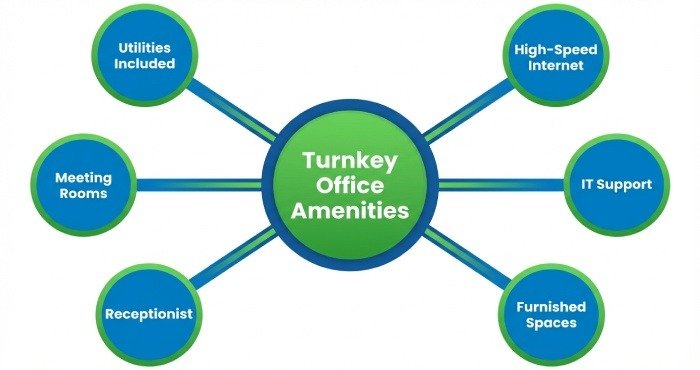
Serviced office providers deliver a complete operating stack: furnished offices, high-speed Internet, printing, phone answering, and on-site teams who maintain the reception area, conference rooms, and common spaces.
1. Turnkey Amenities That Matter
- Meeting rooms and conference rooms are bookable by the hour or day
- Receptionist services and a polished reception area for guests
- Secure IT, mail handling, and an official mailing address or a local mailing address
- Lounge areas and coworking zones for informal collaboration
- Virtual offices for market presence without permanent desks
- Predictable, All-In Pricing
An all-inclusive plan simplifies budgeting: utilities, cleaning, security, and furniture included. You can rent office space that matches your budget and scale it as needed, shifting from an interior office to a window office or adding team suites during peak demand.
- Technology and Support
Beyond high-speed Internet, many centers provide call routing, a dedicated phone number, video-enabled meeting rooms, and on-site help so your workspace is fully operational on move-in.
2. Flexible Terms and Customizable Options
Flexible agreements let you scale month-to-month or on short commitments. Customizable options span branding, layout of private office or executive suites, and the mix of coworking access, virtual offices, and part-time office plans. These solutions balance privacy with access to a broader professional network.
- Office Types to Fit Every Team
- Private office for individuals and small squads
- Executive suites for leadership teams and client-facing groups
- Team suites for project delivery, war rooms, or seasonal spikes
- Virtual offices for presence, phone answering, and mail services
- Hot desk access to complement hybrid schedules
Use Cases and ROI: Startups to Enterprises
Startups and SMBs use serviced office environments to move in quickly, avoid capex, and project credibility with executive suites and a staffed reception area. Mid-market firms deploy team suites for agile initiatives and leverage virtual offices to test new markets. Enterprises roll out satellite hubs near talent clusters, pairing coworking passes with bookable meeting rooms.
Project Teams and Seasonal Demand
For mergers, implementations, or product launches, team offices within a serviced office give project teams secure space and shared conference rooms without a long lease. When the project ends, you scale down under flexible agreements.
Satellite Hubs and Suburban Access
Companies blend urban HQs with suburban serviced office hubs in Plano, Allen, McKinney, Grapevine, Southlake, Keller, Las Colinas, and The Woodlands, plus core markets like Dallas, Fort Worth, Houston, Atlanta, Phoenix, and Nashville. Staff save commute time, meet clients in person locally, and still access executive suites or team suites as needed.
Financial Returns and Intangibles
ROI comes from speed-to-occupancy, reduced downtime, and avoiding buildouts. Bundled amenities, meeting rooms, receptionist services, and virtual offices create a consistent client experience. The ability to swap an interior office for a window office, or to add coworking passes during hiring spikes, prevents overpaying for underused space while sustaining a professional environment.
Choosing the Right Provider and What’s Next
Selecting a partner involves comparing cost models, evaluating hidden fees, and pressure-testing service quality.
Cost Models and Hidden Pitfalls
- Pricing: confirm what “all-inclusive” covers (IT, printing, cleaning, meeting rooms).
- Flexibility: validate flexible terms, expansion rights for team suites, and notice periods.
- Add-ons: ask about premium meeting rooms, after-hours access, and phone number setup.
- Transparency: watch for charges on mail handling, virtual offices, or guest hours.
Location Strategy and Provider Examples
Prioritize proximity to clients, transit, and talent. Look for a network that spans city centers and suburbs for hybrid use. For example, Lucid Private Offices operates across Dallas-Fort Worth and beyond, with access points in Dallas, Fort Worth, Houston, and neighborhoods such as Plano, McKinney, Allen, Las Colinas, Southlake, Keller, Grapevine, and The Woodlands, as well as regional markets like Atlanta, Phoenix, and Nashville. The breadth of office space choices from private office layouts and executive suites to coworking lounges supports multi-market teams.
To research options, many providers let you book a tour online; others invite you to contact us via a form or phone number. When you’re ready to rent office space, verify the official mailing address format for compliance and ensure the workspace aligns with your brand standards.
ESG, Wellness, and Community
Modern serviced office providers prioritize energy efficiency, wellness rooms, and recycling programs. Ask how buildings source power, manage air quality, and provide green transit options. Community programming mentor sessions, meetups, and a professional network add value beyond the square footage, especially when combining coworking with private office and team suites.
Future Trends: Tech-Enabled Flexibility
Expect deeper integration of booking apps for meeting rooms and conference rooms, unified communications within virtual offices, and AI-assisted workplace analytics. Flexible agreements will become even more granular, allowing businesses to toggle between executive suites, team suites, and coworking capacity month-to-month. Customizable options from modular walls to brandable digital signage will let companies reshape office space layouts rapidly. For additional insights and comparisons across workspace models, see eclat.com.